

By: Donovan Smith, MSc
MD/PhD Candidate – University of Calgary
I want you to take a moment and think back to the COVID-19 pandemic. Do you remember the uncertainty, and the sense that the future itself was on pause? As a species, we collectively yearned for reprieve from the virus that was keeping us apart. At times, it was hard to imagine when, or if, life would return back to normal. Then, we got a glimpse of the light at the end of the tunnel. Through unprecedented global collaboration and billions of dollars in federal funding from multiple countries, scientists around the world worked tirelessly to find a solution. The United States National Institutes of Health (NIH), which is the largest public funder of biomedical research globally1, played a central role in advancing these efforts and supporting the science that would change the course of the pandemic.
That science centered on a new approach: messenger RNA, or mRNA. This molecule carries genetic instructions that allow scientists to “teach” cells in the body to make specific proteins, such as those that trigger an immune response to a virus. Using this technology, researchers developed mRNA vaccines against COVID-19, offering much-needed protection for people around the world. Miraculously, we made it through the worst pandemic the world had seen in over a century. Yet the very system of global collaboration and public investment in science that made this breakthrough possible now faces an uncertain future.
As of June 4th, 2025, the current United States administration has terminated nearly 800 NIH-funded grants, representing close to $3.8 billion of lost funding to American medical schools, hospitals, and other research institutions2. Then, on August 5th, the US Health Secretary announced the cancellation of an additional $500 million in grants and contracts, specifically targeting mRNA vaccine development, ending 22 separate research projects3,4, some involving global pharmaceutical leaders such as Pfizer and Moderna. Considering the significant financial contribution the NIH provides for biomedical research globally, a pressing question emerges: what does this mean for the future of health research, and mRNA vaccine development in particular?
Beyond their now-familiar role in fighting infectious respiratory diseases like COVID-19, mRNA vaccines have also shown great promise in the field of cancer research5. Recent work has found that mRNA vaccines can instruct cells to produce tumour-specific proteins, effectively teaching the immune system to recognize and attack cancer cells in some patients6,7. These breakthroughs demonstrate that mRNA’s potential reaches far beyond COVID-19, making the loss of funding even more concerning. Still in the early stages of clinical trial testing, scientists warn that funding cuts to mRNA research risk stalling this momentum and delaying the arrival of desperately needed novel cancer therapies8.
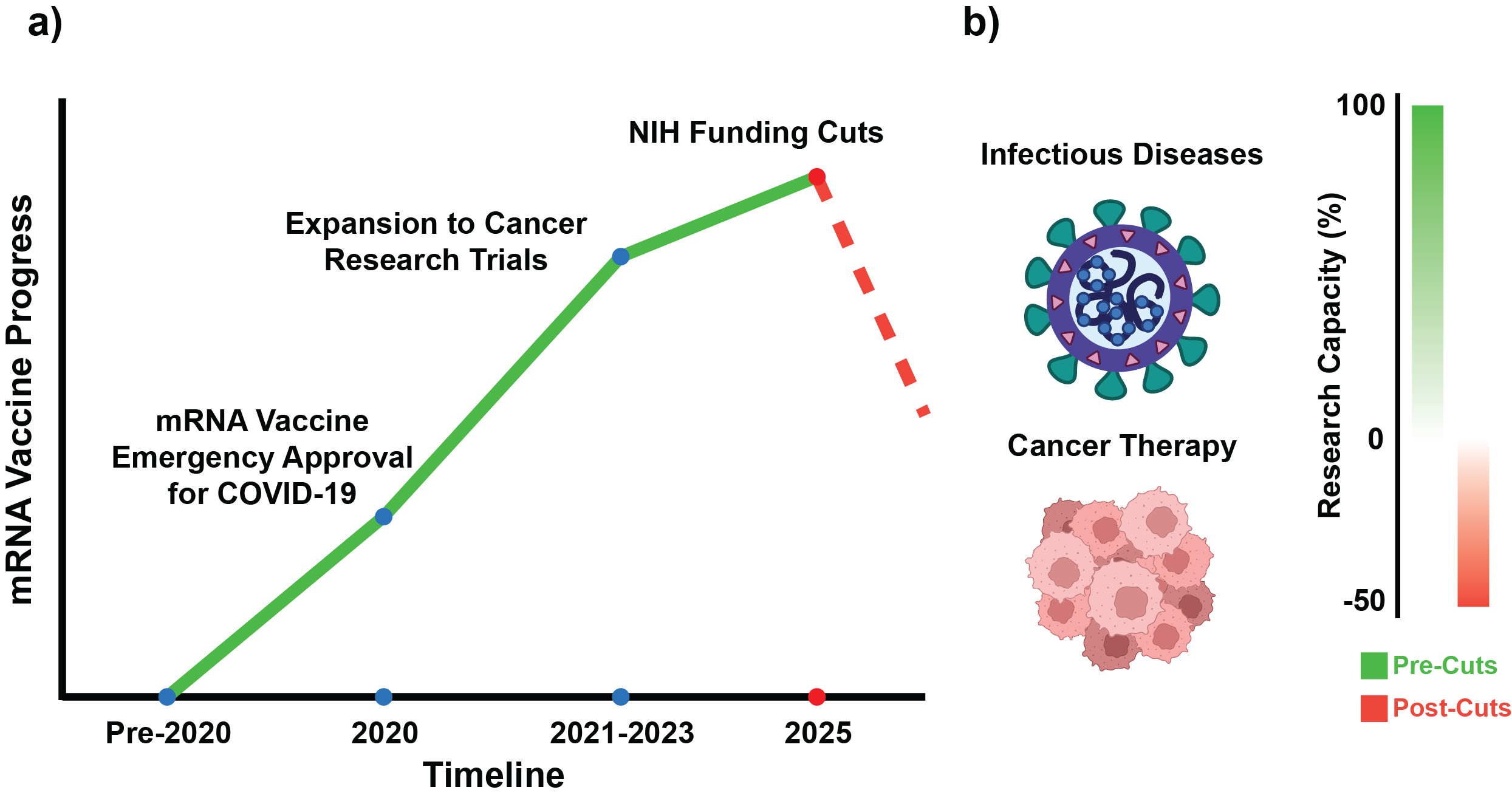
Figure 1 – The rise and stall of mRNA research. a) Timeline of mRNA vaccine progress across multiple domains both before and after the introduction of NIH funding cuts, b) Theoretical change in research capacity of mRNA vaccines for both infectious diseases and cancer therapy with NIH funding cuts.
Concern also surrounds our global preparedness for future epidemics and pandemics, as mRNA vaccines represent a versatile technology that can be tailored to combat emerging viruses. Curtailed funding from the NIH has infectious disease experts worried that our response to the next pandemic may not be as swift as it was for COVID-19, risking precious time and endangering lives worldwide.
Thankfully though, not all the recent news is doom and gloom, and mRNA research is far from finished. Even amid federal funding cuts, the US Department of Defense continues to financially back mRNA projects for pandemic preparedness, stepping in where civilian funding has retreated. Further, cancer vaccine development using mRNA technology also continues to advance elsewhere in the world, with the European Union and China investing heavily despite the U.S. stepping away9. Finally, scientists around the globe have condemned the NIH funding cuts, urging renewed support to sustain progress in this field. These efforts remind us that while funding landscapes shift, the collaborative spirit and ingenuity that carried us, and our scientists, through COVID-19 can still shape a healthier future. Sustained investment in mRNA research isn’t just about vaccines - it's about the future of modern medicine.